
What is a data privacy vault, and why self-host one?
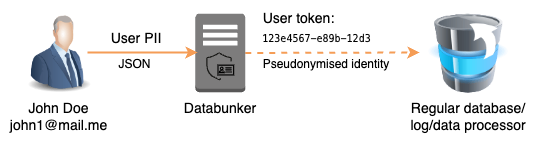
A data privacy vault is a dedicated, isolated store for sensitive data — PII, PHI, payment, and KYC — that every other system references through tokens instead of holding the real values. Rather than personal data spreading across your database, logs, analytics, and SaaS tools, it lives in one hardened place, and everything else keeps only de-identified tokens. IEEE has described this isolate-protect-govern pattern as the future of privacy engineering.
Databunker is a data privacy vault you can self-host — open-source heritage, single-tenant, hostable in your own region — so you get the architecture without handing your customers’ data to another SaaS.
The problem it solves: data sprawl
Personal data multiplies. A single signup writes an email to your database, and copies soon land in analytics, a CRM, application logs, a data warehouse, backups, and a handful of SaaS tools. Every copy widens your attack surface and pulls another system into compliance scope. This data sprawl is the root cause of most breaches and most audit pain.
How a data privacy vault works
The pattern is straightforward:
- Store each sensitive value in the vault.
- The vault returns a token in its place.
- Your apps, databases, logs, and analytics keep the token, not the data.
- Authorized code retrieves or reveals the real value through a controlled, audited API.
The result is that your operational systems become de-identified. A breach of your app database, a leaked log, or a stolen analytics export exposes tokens, not people. Vaulted architectures typically remove 70–90% of systems from PCI DSS, HIPAA, and GDPR audit scope, because far fewer of them ever touch real data.
What Databunker Pro gives you
- Strong encryption — AES-256 at rest (FIPS 140-2) and TLS in transit; nothing is stored in clear text.
- Tokenization — sensitive values are replaced with tokens that keep your schema and joins intact. See PII tokenization.
- Granular access control — conditional role-based access control (CRBAC) and field masking enforce least privilege; bulk extraction is default-deny and audited.
- Tamper-evident audit logs — who accessed what, and when — ready for audits and incident investigations.
- Data subject rights — a passwordless privacy portal lets users access, correct, or delete their data, with consent records and withdrawal callbacks built in.
- Self-hosted multi-tenancy — run it in your own cloud or on-prem, in the jurisdiction you choose, with tenants isolated at the database layer via PostgreSQL row-level security.
This is the same critical data segregation pattern, packaged as a product.
Vaulted vs. vaultless
You’ll see “vaultless tokenization” marketed as simpler. It trades a central, governable store for tokens derived algorithmically — which widens the trust boundary and complicates key management, deletion, and audit. Databunker is a vaulted design on purpose: one isolated, encrypted, access-controlled, auditable place where deleting a record actually removes it.
Self-hosted vs. SaaS vaults
Most data-privacy-vault products are SaaS, which means your customers’ PII ends up in the vendor’s cloud. Databunker is self-hosted: you keep custody, pick the region (which matters for GDPR, Schrems II, and data residency), and avoid adding another processor to your data map. That makes it a practical open-source, self-hosted alternative when a hosted vault isn’t an option.
Especially useful for fast-moving and regulated teams
Startups in fintech, health tech, and e-commerce face GDPR (up to €20M or 4% of revenue), CCPA, and HIPAA from day one — usually without a dedicated privacy team. A vault turns compliance from a custom build into an integration: RESTful APIs and SDKs, scaling from your first user to millions, replacing costly bespoke compliance code with a single component you can stand up quickly.
Summary
A data privacy vault isolates sensitive data so the rest of your stack holds only tokens — shrinking your breach blast radius and your audit scope. Databunker Pro delivers that architecture self-hosted: encryption, tokenization, access control, audit, and data-subject rights in one place you control.
Frequently asked questions
What is a data privacy vault? A dedicated, isolated store for sensitive data that the rest of your systems reference through tokens, so personal data lives in one governed place instead of spreading everywhere.
How is it different from just encrypting my database? Encryption protects data where it already sprawls; a vault removes the data from those systems entirely, leaving only tokens — so a breach of them exposes nothing.
Vaulted or vaultless — which is better? Vaultless is simpler to deploy but spreads the trust boundary; a vault gives you one auditable place to govern access, rotate keys, and guarantee deletion. Databunker is vaulted.
Can I self-host a data privacy vault? Yes — Databunker runs in your own cloud or on-prem, in the region you choose, so customer PII never leaves your control.
Get Free SOC2 / GDPR / DPDP Compliance Report
A free 30-minute working session with our compliance team — across SOC 2, ISO 27001, GDPR, HIPAA, DPDP and PCI DSS. We map every gap in your cloud and databases to the exact clause it violates, then send you a written remediation roadmap. Read-only access. No infrastructure changes.
Book My Free Compliance Assessment 🚀 Learn more →✓ 30-min call · ✓ Written assessment · ✓ No credit card required