
How to implement data segregation for security and GDPR compliance
Online privacy and data protection are now board-level concerns, driven in large part by the European Union’s General Data Protection Regulation (GDPR). If your company serves European customers, GDPR compliance is non-negotiable, wherever you are hosted.
One of the most effective technical measures you can take is critical data segregation — separating your most sensitive data from everything else, so a breach of the rest never exposes it. This article explains what data segregation is and how Databunker Pro implements it.
What is data segregation?
Data segregation is the practice of separating sensitive or critical data from less sensitive data within a system or organization. The goal is to limit the blast radius of a breach and tighten access to the information that matters most. It is exactly the kind of measure GDPR’s Article 25 — data protection by design and by default calls for, and it directly supports data minimization and access limitation.
Physical, logical, and network segregation
Segregation comes in a few flavours:
- Physical — sensitive data on separate hardware or in a separate data centre.
- Network — isolating segments with VLANs or subnets to limit lateral movement.
- Logical — separating data sets and access within shared infrastructure.
Databunker provides strong logical segregation: it pulls personal data out of your application database into a dedicated, encrypted vault — without forcing you to re-architect your infrastructure.
Key aspects of effective segregation
A complete strategy usually covers:
- Data classification — know which data is sensitive before you can separate it.
- Separation of data — keep critical data apart, logically or physically.
- Access controls — restrict critical data to authorized roles only.
- Encryption — protect data even if storage is compromised.
- Monitoring and auditing — detect anomalies and prove compliance.
- Backup and recovery — keep the segregated store resilient.
- Compliance — meet GDPR, and ease SOC 2, HIPAA, and PCI DSS obligations.
How Databunker Pro implements data segregation
Databunker Pro turns those aspects into concrete mechanisms:
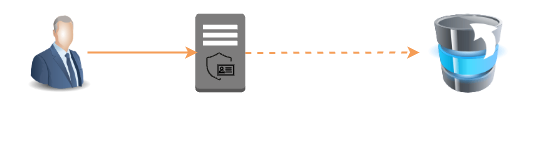
- Tokenization — the strongest form of segregation. Databunker replaces personal data in your main database with opaque tokens; the real values live only in the vault. Your app database, logs, and analytics then hold tokens, so a breach of any of them exposes nothing usable.
- A dedicated encrypted vault — PII, PHI, KYC, and PCI data stored with per-record AES-256 encryption (FIPS 140-2), isolated from your operational systems.
- Multi-tenancy with PostgreSQL Row-Level Security — tenants are cryptographically isolated at the database layer, so one can never read another’s data.
- CRBAC and field masking — conditional role-based access control decides who may see which fields; bulk access is default-deny and audited.
- A tamper-evident audit trail — every read and change to a record is recorded.
In short, your main systems keep tokens; the people, payments, and health data they refer to stay segregated in the vault. See data privacy vault and PII tokenization for the underlying patterns, and the Databunker Pro security overview for the full security model.
Why it shrinks your breach blast radius
When a web app is breached, attackers reach your application database — but with Databunker in place, it holds tokens, not identities. The real personal data stays isolated behind the vault’s separate encryption and access control. The same separation keeps PII out of your logs and away from dev and staging, and shrinks PCI DSS and GDPR audit scope because fewer systems touch real data. Collecting less to begin with helps too — see data minimization and PII data protection.
Summary
Critical data segregation limits what an attacker — or a misconfiguration — can ever reach. Databunker Pro delivers it as logical segregation: tokenize personal data out of your main database, store it in an isolated encrypted vault, and gate every access with CRBAC and audit. Your blast radius shrinks, and Article 25 “by design” stops being a slogan.
Frequently asked questions
What is data segregation? Separating sensitive data from the rest of your systems so a breach of the rest can’t expose it, and only authorized roles can reach it.
Data segregation vs. data isolation — what’s the difference? They overlap: segregation emphasizes separating data by sensitivity, isolation emphasizes preventing one data set (or tenant) from reaching another. Databunker does both — a separate vault, plus tenant isolation via row-level security.
How does segregation help with GDPR? It implements Article 25 (data protection by design and by default) and data minimization, and limits the personal data exposed in a breach.
Which type of segregation does Databunker provide? Logical segregation — a dedicated encrypted vault and tokenization — so you don’t need separate hardware or a network rebuild.
Get Free SOC2 / GDPR / DPDP Compliance Report
A free 30-minute working session with our compliance team — across SOC 2, ISO 27001, GDPR, HIPAA, DPDP and PCI DSS. We map every gap in your cloud and databases to the exact clause it violates, then send you a written remediation roadmap. Read-only access. No infrastructure changes.
Book My Free Compliance Assessment 🚀 Learn more →✓ 30-min call · ✓ Written assessment · ✓ No credit card required